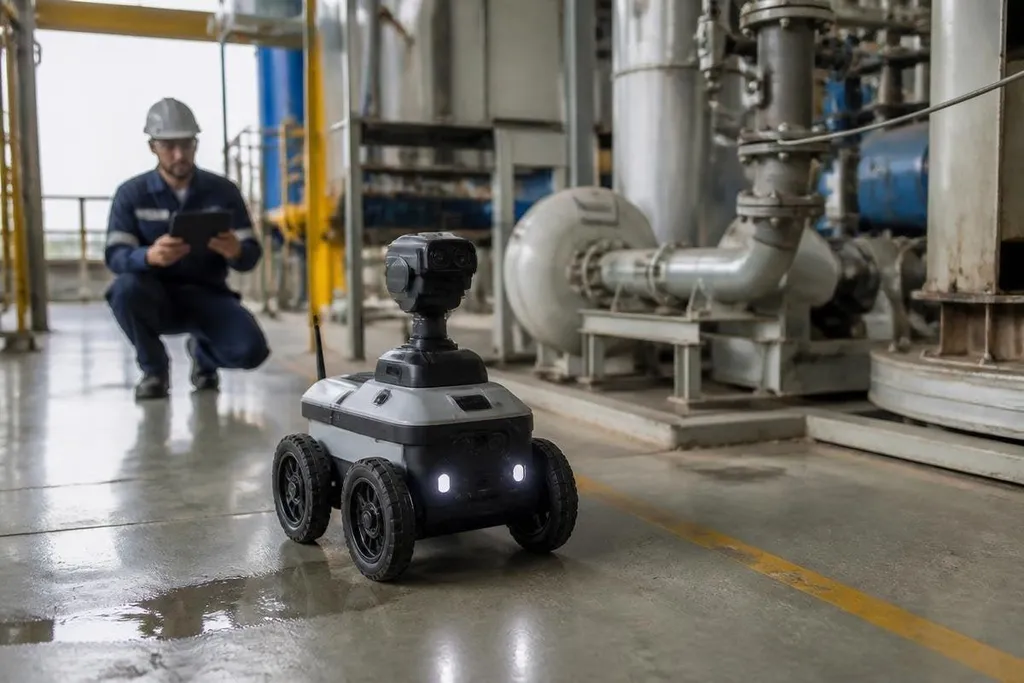
A maintenance robot’s first useful job may be a slow inspection, not a wrench turn. Machines can already move through fixed spaces, carry sensors, and send findings to a person, but unsupervised repair remains a harder task.
Quick read:
- Inspection is the safest early use because the robot can report before it acts.
- Remote supervision will remain part of many maintenance jobs.
- Buying decisions should start with access, downtime, and proof from the work site.
Inspection comes before repair
A robot can follow a planned route around equipment and record images, sound, temperature, or vibration. Those readings can point a technician toward a loose cover, a hot bearing, or a change that needs a closer check.
The robot does not need to understand an entire factory to help. It needs a repeatable route, a useful sensor, and a way to send the result to the person responsible for the equipment. That narrower task is easier to test than a robot that chooses tools and fixes faults on its own.
The handoff matters. A technician still needs to confirm the fault, decide what work is safe, and arrange access to the equipment. If the robot finds a problem but gives poor images or unclear location data, it adds another step instead of removing one.
The work will stay shared
Fully autonomous maintenance sounds neat on paper. Real sites contain blocked paths, changing lighting, wet floors, damaged labels, and equipment that differs from the plan. A robot may handle the known route while a person deals with the part that does not match its map.
That person may work from a control room or from another part of the site. Remote operation can let one technician guide the robot through an unusual task, then return it to its normal inspection route. The number of people one operator can support will depend on the robot, the site, and the number of interruptions.
Remote operation matters when it helps a technician finish a repair, not when it only moves the task to another screen. A maintenance manager can use Robot24 to follow reports that tie the robot’s route to the fault, the repair task, and the date. The next question is what tools the robot needs once inspection ends.
Repair needs more than a robot arm
A repair robot needs to locate the fault, reach the part, choose a tool, apply the right force, and confirm that the fix worked. Each step can fail for a different reason.
A machine that turns a known valve in a test area may struggle with a valve covered in dirt or partly blocked by another component.
Safety adds another limit. Maintenance often happens near stored energy, moving parts, heat, chemicals, or heavy objects. The robot needs a safe stop, clear operating boundaries, and a process for a person to take control. Those controls matter more than a smooth movement in a short demonstration.
I'd skip any purchase whose maker can't show how the robot handles a missed reading, a blocked route, or a human takeover.
What buyers should measure
For a maintenance manager, the decision gets clearer by checking the job before checking the robot. The right system may be a mobile platform, a fixed sensor setup, or a tool used by a technician rather than an independent machine.
Use this checklist during a site review:
- Name the route: mark doors, stairs, narrow gaps, floor changes, and places where the robot must stop.
- Set the proof: choose the fault signs the sensors must find and record how a person will verify each result.
- Count the handoffs: write down when a technician must approve movement, inspect a fault, or take control.
- Measure the delay: compare the time between a reading and a confirmed work order, not only the robot’s travel time.
- Price the edges: include charging, sensor replacement, software, training, and changes to the work area.
A pilot should run on a real inspection route with normal interruptions. A clean test area can show movement, but it says little about access, data quality, or the time saved during a working shift.
The next test is repeatability
Maintenance robots will earn their place by finding the same useful signal over many inspection rounds and passing clear evidence to a technician. Repair will follow only when the robot can act safely in spaces that change from one visit to the next.
The open question is not whether robots can move around equipment. It is how often they can find a real fault, explain what they saw, and do so without creating another task for the maintenance team.